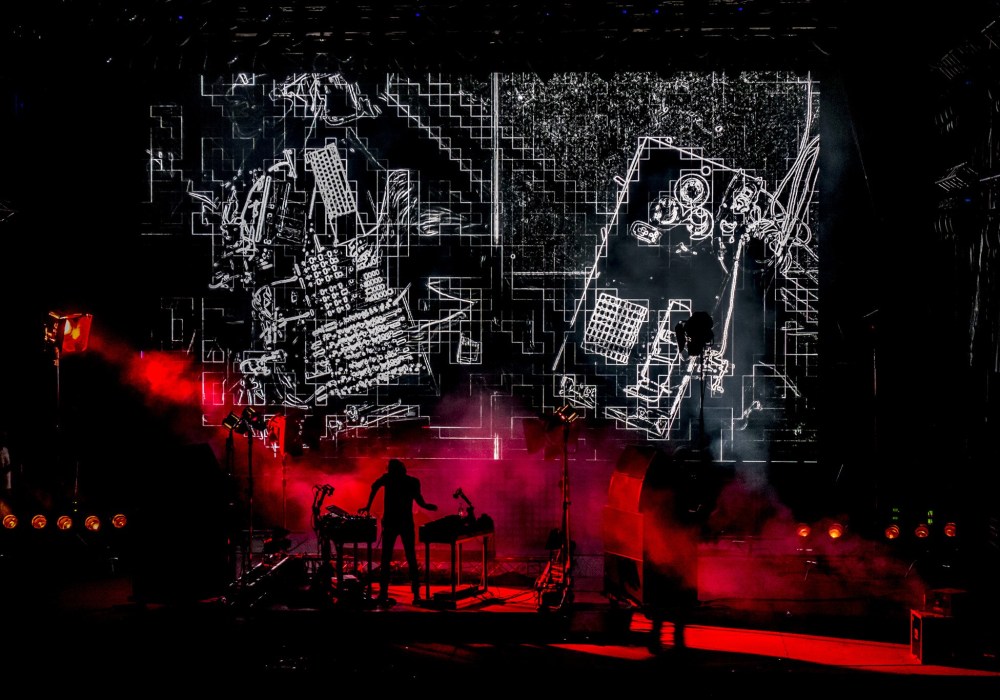
As a keen techno producer and videographer, why is it my desire to research the incorporation of cymatic motion visuals within music projects? Perhaps this emerges from a need to satisfy the lack of fully immersive, stimulating audio and visual experiences at club events. In the last decade it has become apparent through anecdotal evidence, that the typical experience at a small or moderately sized club or music event can not always be the fully immersive, escapist scenario akin to a concert or festival. In the smart phone age of distraction, perhaps attention spans are becoming shorter with a constant need to diversify one’s stimulation of the senses. We appear to spend more time staring into screens than embracing a moment to think, feel and absorb any given environment.
The emergence of techno in 1980s Detroit enabled people to go to a dark room with simply a strobe light and loud music, in a bid to cut off and escape from their daily burdens of life while embracing common unity with others. Some establishments pertain to uphold this significance in their venue aesthetic or event vision, with Tresor in Berlin being the first such place that springs to mind.
Tresor, which was founded in 1991 on the site of an abandoned bank in the former East of the city, presented the Detroit aesthetic of techno in post-wall Berlin. The basement ‘tresor’, German for vault, or safe, in the abandoned bank building proved to be a perfect setting for conceptualising a dark space for dancing to loud techno music. This methodology has ensued for over 25 years at Tresor, with the club recreating the bank-vault environment in a new, central Berlin location in 2007.
How does Tresor influence my work? Having personally visited Tresor on several occasions in the last two years, it maintains the provision of a totally immersive and stimulating, yet simplified form of expressive escapism. It has been responsible for influencing the direction of my work, leaning towards more raw, industrial style of techno. My most memorable experience of Tresor was in January 2016, when I was struggling with a creative block and poor mental health. I had travelled to Berlin with family and decided to take a last minute solo trip to the club after feeling inspired to take some USB flash drives containing my own music. After having the most immersive, inspirational experience on the dancefloor I broke the rules and walked into the DJ booth. I handed the DJ, Lewis Fautzi, a USB flash drive hoping that he might like something I had produced. A few days later he emailed me asking to license a track to his record label. This was to be released eighteen months later on a compilation CD, along with many of my favourite techno producers and DJs. Below are a selection of tracks inspired by Tresor, plus the music release as a result of my trip to Tresor. Although a tangential story, straying from the point – this is how I overcame a creative block, which subsequently led to make some of my best work yet.
(Jones, 2017a)
(Jones, 2017b)
(Jones, 2017c)
(Jones, 2017d)
The excitement as you proceed along the tunnel with flashing LED lights leading you to the vault for the first time, amid the ever-increasing volume of pulsating bass captivates ones attention with predominance, as does the slight apprehension as to what is waiting at the other end.

Tresor – Tunnel to the vault
(Tresor Berlin, 2009)
Emerging into an industrial space engulfed in smoke, blinding strobes and loud, bass-heavy techno can be overwhelming enough to immediately encourage or deter anyone. In the midst of the dance floor, you cannot easily get a cell phone signal, have a conversation or see the DJ and those around you at peak strobe and smoke moments. There are no visual displays at Tresor, except for being able to see the retinal blood vessels flashing in your own eyes in time with the penetrating strobe and pulsating music. A secondary dancing space upstairs in the Tresor complex, named Globus, provides a more conventional style of club space. This is a brighter room, with warmer, ambient lighting, house styled music and a decreased immersive experience adding to a greater social factor.
(Blaha, 2015)
Is this a typical, modern approach to embrace? The style of Tresor and the roots of the Detroit aesthetic are merely one side of the coin as far as immersive music and visual experiences go, when considering their subjective nature to the individual. Upon reflection, if I am not in a situation like Tresor where all you can do is embrace the moment out of the sheer inability to do anything else, there needs to be powerful, stimulating and captivating visual art on display. I feel this is also a strong factor of enhanced artistic expression for any DJ or music performer to maintain the audience’s engagement with immersion.
My experience of Tresor is merely one type within a broad range of variables, primarily determined by, but not limited to the musical style being expressed in any given setting. To gain an understanding of diverse escapist environments within music events, I feel compelled to examine an alternative scenario. If we consider a handful of the current, most critically acclaimed and legendary techno DJs in the music scene, such as Carl Cox (UK), Adam Beyer (SWE), Chris Liebing (GER), Richie Hawtin (CAN), Jeff Mills (USA) and Ben Klock (GER), there are some similarities as to the nature of their performance environment. In recent years you are more likely to see the aforementioned at large concerts and music festivals performing to thousands of people along with full visuals and pyrotechnics, as opposed to smaller, intimate venues such as Tresor.

Figure 2: Richie Hawtin
All are pioneers in their own right and have contributed towards the techno scene, whether through developing technologies, record labels, events, or just making great music. Take Richie Hawtin, a personal favourite of mine and even though my preference of techno music leans more towards purist, darker timbres in recent years, he continues to astound me with his immersion in expression project approach to the music scene.
He is responsible for the inception of Contakt, Plastikman, ENTER. and CLOSE shows, all relevant to his artistic merit as a DJ and music producer. Hawtin’s vision for Contakt in 2008 was for him and affiliated record label artists to be on stage in a DJ, live performance ‘jam’ infusion scenario. This would require multiple performers with computers running Traktor Pro or Ableton Live performance software, tempo synchronised via MIDI clock from Hawtin’s master computer.
A major element of the Contakt shows was the visual artistry on display from Ali Demirel, which surrounded the artists on stage in the form of curved background and DJ booth LED screens. I attended two Contakt shows in London at different size venues, which in reflection determined the overall experience of each, although all artists performing were present on both occasions.

Figure 3: Contakt Stage & LED Screen – Visuals by Ali Demirel (Demirel, n.d.a)
The first Contakt show I attended in October 2008 was held at SeOne, a former venue under the arches of London Bridge station. The intimate size of the venue determined a smaller sized visual LED display, which could not easily be seen from all areas of the packed dance floor. There were too many people, no space to move let alone dance or enjoy the music and visual hybridity unfolding. This event was considered one of the most challenging and frustrating for Hawtin and his team on the tour, not just the audience who attended. Personally, it was a night best forgotten.
Fast forward to September 2009 and Brixton Academy, now primarily known as the O2, was host to the final Contakt show. This special ‘one off’ proved to be much more suited to the venue which complimented the scale of the show, and provided a greater overall experience. This was one of my most memorable event experiences, as you could be fully immersed in the loud, warm sound pulsing from the Funktion One system and Demirel’s stunning visuals wherever you were in the auditorium. A beautiful aspect of Brixton Academy is the grandiose floor area in front of the stage, typically named ‘stalls’ for seated occasions, where you can look up to the stage and absorb the impact of the sound and visual stimulation. Alternatively, there was the tiered balcony area which provided an opportunity to sit down, with a great view, to watch the visual show while enjoying the music.

Figure 4: Ali Demirel performing at ENTER. (Demirel, n.d.b)
Demirel has worked with Hawtin on other show projects since the inception of Contakt almost ten years ago, notably the Plastikman Live tour in 2011, ENTER. from 2012 onward and CLOSE (featured image) in 2017. His style of visual art has gradually transitioned from typically minimalist elements to include more vibrant, colourful and complex pieces.

Fig 5: Richie Hawtin – Plastikman Live – Visuals by Ali Demirel (Demirel, n.d.c)
The following video provides an insight into the performance of Hawtin’s CLOSE show, demonstrating the audio and visual hybridity of the immersive concept in techno music expression.
(Hawtin, 2017)
Why is this relevant to my creative aspirations? Personally, I really admire Hawtin and Demirel’s creative vision in expression. As an artist, it is an avenue of complexity that I wish to encompass within my own music and visual hybrid projects throughout my masters degree and beyond.
References:
Jones, C. (2017a) ‘Sejon – Hyper [Unsigned]. [Online]. Available at: https://soundcloud.com/chris-jones/sejon-hyper-unsigned-4/s-lbvh3?in=chris-jones/sets/track-examples-2-uh-research-enquiry/s-EYPD6 [Accessed: 06 December 2017].
Jones, C. (2017b) ‘Sejon – Interdimensional [Unsigned]. [Online]. Available at: https://soundcloud.com/chris-jones/sejon-interdimensional-2/s-LRdun?in=chris-jones/sets/track-examples-2-uh-research-enquiry/s-EYPD6 [Accessed: 06 December 2017].
Jones, C. (2017c) ‘Sejon – Dark Fleet [Unsigned]. [Online]. Available at: https://soundcloud.com/chris-jones/sejon-dark-fleet-unsigned-3/s-ibkpA [Accessed: 06 December 2017].
Jones, C. (2017d) ‘Sejon – Dreamers [FAUT SECTION]. [Online]. Available at: https://soundcloud.com/chris-jones/01-sejon-dreamers-faut-section/s-guKSz?in=chris-jones/sets/sejon-forthcoming-tracks-2017/s-5en2w [Accessed: 06 December 2017].
Tresor Berlin. (2009) ‘The tunnel to the vault’. [Online image]. Available at: https://www.flickr.com/photos/tresorberlin/6097984729 [Accessed: 03 October 2017].
Blaha, P. (2015) ‘Tresor Techno Club’. [Online]. Available at: https://youtu.be/FJd7x8cRqbQ [Accessed: 03 October 2017].
Demirel, A. (n.d.a) ‘CONTAKT Live Visuals 2008’. [Online image]. Available at: http://ali-m.de/works/contakt/
Demirel, A. (n.d.b) ‘ENTER Concepts 2013-2015’. [Online image]. Available at: http://ali-m.de/works/enter_international/ [Accessed: 04 October 2017].
Demirel, A. (n.d.c) ‘PLASTIKMAN LIVE, The Cage // stage design & visual concept / 2010-2011’. [Online image]. Available at: http://ali-m.de/works/plastikman_cage/ [Accessed: 04 October 2017].
Hawtin, R. (2017) ‘Richie Hawtin CLOSE – Emery Warman – Miami Connection (Whyt Noyze Remix) Live @ Coachella 2017’. [Online]. Available at: https://youtu.be/6mpuaAAUkW8 [Accessed: 04 October 2017].
#Reflection
 Sonic Fluidity