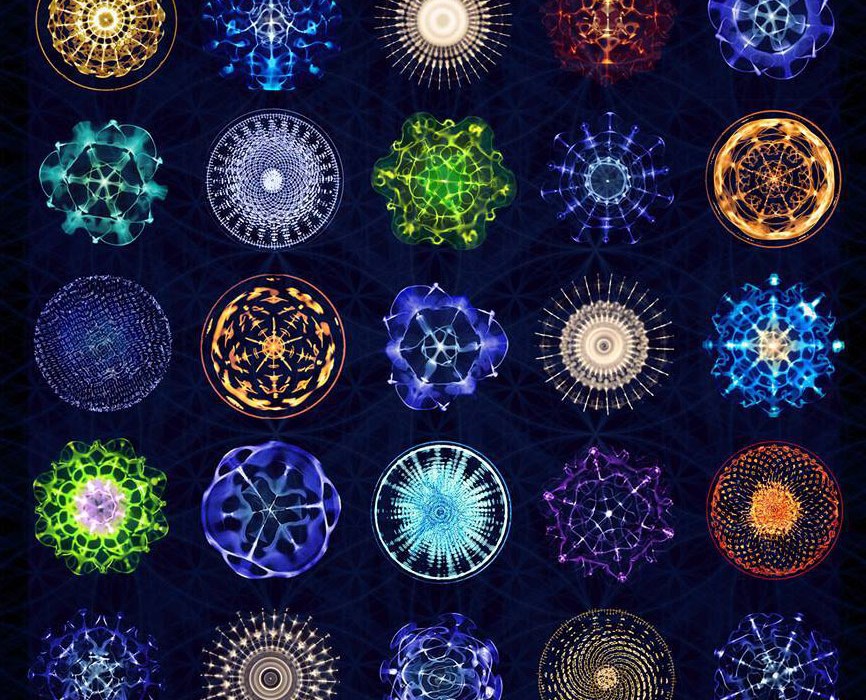
My research is progressing but it is still in its early stages. Having discovered a paper written in 1983 exploring the potentiality of cymatic music, it has once again triggered my thoughts into questioning why there is not more widely accessible, mainstream scientific sources regarding cymatic frequency in general. The paper I refer to, although not specifically relevant to the focal point of my research, expresses the beginning of a potentially exciting future regarding the utilisation of emerging electronic art technologies and their capabilities in sound and light (Pellegrino, 1983). However, there remains limited widespread knowledge on the potentially informative and educational prospects of cymatic frequency, particularly regarding matter.
My research is primarily aimed towards its use for visual art and unlike the anticipation of the author, thirty-six years later, there seems to be a lack of evident experimentation in mainstream art. That could be a bold, foolish statement at this stage. Perhaps I am not looking hard enough and yet to find more examples that merit peer-reviewed publication, or millions of plays on YouTube. It is apparent from my perspective, that most mainstream, popular or accessible music genres focus their visual art on the individual as opposed to the music or sound element. This could be due to the high presence of vocals in songs. Many artists gain the listener’s attention by singing beautiful, edgy, distasteful or poetic words and perhaps this makes the musical element redundant to merely an enhancement, secondary to vocals.
Personally, I am a fan to a minority of singers, and generally those that I like are where the music is as predominant in the performance as the vocals. This could explain why I primarily love electronic, techno, soundtrack and instrumental music. Perhaps many music fans are actually fans of the artist’s ego, story or image instead of the music itself? If we took some popular songs and removed the vocal element, would fans still love the instrumental piece as much? Are we capable of being immersed in music enough to generate our own story, vision and escape through imagination, or do we require a voiced rendition of an artist’s experience? Undeniably a vocalist can generate beautiful tones, moods and emotion with song, which is visible in cymatic response, but is it more powerful than the music can be itself?
(Stanford, 2014)
A great example of experimenting with cymatic frequencies in a contemporary, innovative concept is the above video from Nigel Stanford. With over fourteen million views on YouTube, it could be considered as the most widely seen cymatic frequency experiment on the Internet. Utilising the ‘Chladni plate’, ferro fluid and other devices, Stanford presents a brilliant experiment showcasing the wonder of cymatic frequencies in real-time. If other music videos took this example, perhaps fans would be investigating science through artistic expression instead of embracing ego? That is an entirely different debate, but perhaps in being tangential I am merely expressing thoughts that occurred while exploring Pellegrino and Stanford’s work.

‘CYMATICS: Science Vs. Music – Nigel Stanford’
As we head towards the fourth week of this module, I have to touch base with the plausibility factor of actually being able to thoroughly research the question I have given myself. This is perhaps not due to my inability to choose a focal point for research, or knowing where to look, but to the ever more apparent circumstance that there are limited peer-reviewed, or published sources that could be considered high-caliber enough to merit a place in my annotated bibliography.
I am aware that I have expressed my thoughts on the lack of public awareness and minority of academic research on cymatic frequency in general. However in being a minority topic, there are still plenty of viable sources to research cymatics, but not its integration into real-time, music to visual, synaesthesia style performance. On this basis I feel inclined to broaden my research topic slightly away from solely focusing on cymatic frequency as a modern, digital performance initiative. This would mean extending my reach to include real-time sound representative visuals based on the principles of cymatics, not necessarily inclusive of the frequency dynamic as per Dr. Hans Jenny’s experiments.
Even though I am reluctant to make this change, due to my fascination of cymatics and keen artistic intention to integrate them into my future music and visual hybrid work, I have to make a realistic decision which is going to positively impact my completion of this module. Having discussed the likely topics with fellow classmates, many of them were also concerned at the lack of specific peer-reviewed, published sources that could form the backbone of a current and relevant research focal point within the discipline of music technology.
When compared to other artistic disciplines, the creative distinction and technological aspects of music are constantly evolving, perhaps at a rate that has not yet led to an abundance of expert research which other fields may have. That could be a foolish statement, but nonetheless having discussed this with fellow classmates we agreed that we need to be at the forefront of research in our discipline and continue with rigorous intent.
#Reflection
 Sonic Fluidity