Following on from a very helpful tutorial session where I shared my research ideas and prospective future plans with classmates, I was kindly prompted to speak to another lecturer within the university. I was led into a lecture theatre and introduced to Rob Godman, who I explained to the basis of my research. After summarising my intention to utilise cymatic frequency as a form of intuitive music to visual display, he reassuringly replied with great common interest.
We discussed the phenomenon of cymatics and Dr Hans Jenny’s work, of which Godman was somewhat skeptical about the nature of its revelation and interpretation in the new age, spiritual community. He introduced me to another experimental term called ‘Faraday Waves’. This process is specific to the vibrating of liquid, as with sand on a Chladni plate, however the liquid is enclosed allowing for resonating waves to take reflective motion around the container. This is turn produces a myriad of interesting original waves, plus their resonations which are also still subjected to new vibrations. The result is geometrical, symmetrical patterns, formed of lines, squares and hexagons in lattice formations. Whether my interpretation clearly explains this holds a level of uncertainty, however this process has been undertaken by those experimenting with cymatic vibrations as previous examples in this blog have demonstrated.
(Godman, 2017)
Godman showed me a piece of his work, which incorporated his music accompanied by some footage he filmed of Faraday waves during a practical experiment. He explained that a visual artist then reverse engineered the film footage to react to his music in an intuitive manner. Personally, I think this is a beautiful piece that demonstrates the organic methodology of utilising a physical medium to capture visuals, but also the potentiality of software to infuse with music. Godman expressed his preference towards this practice over using software entirely to replicate Faraday waves, primarily due to the organic nature of practical experimentation.
To consider this philosophy towards my intention of achieving real-time music to visual intuition in a live, immersive performance setting, perhaps Faraday waves are potentially more plausible in physical practice? I felt positively overwhelmed after spending a short time with Rob Godman and upon reflection it made me consider thoughtfully what lies ahead.
The prospective idea of having a physical installation with a live camera feed, mixed with visuals sourced from a chosen software application, could be considered a strong contender in achieving this objective in a real-time, live performance setting.
Spending time exploring the potentiality of using physical installations, such as a Chladni plate and Faraday waves in a real-time scenario, I have come to the conclusion that this could be plausible in a controlled environment with the correct tools. However, I am still yet to answer the question as to whether visual formation of cymatic frequencies, or Faraday waves can be replicated with intuitive, algorithmic software?
Until now my focus has been primarily on researching various scientific experiments through peer-reviewed sources, to gain an understanding if such physical practice can be adopted in a music to visual performance setting. Although this approach would be feasible with a physical installation, plus live camera feed, there would need to be software incorporated to enhance the colour, texture and offer additional visual variation. Researching software usage for specifically replicating cymatic frequency and Faraday waves has gained few results, however there is potential in the visual applications available.
Jitter, which was released in 2003, is an additional facet to the programming language capabilities of Max/MSP. Specifically for 2D, 3D video graphical composition, it is notably capable of designing algorithmic image generators and audio visualizers for real-time display (Products of Interest, 2003). Reading this small account in the Computer Music Journal led me to research more detailed publications regarding the specific programming process in generating intuitive audio visualizers. Having discovered the book ‘Multimedia Programming Using Max/MSP and TouchDesigner’, it is apparent that Patrik Lechner (2014) has constructed an easily understandable text for the benefit of readers wishing to learn this style of programming.
(Landon Speers, 2009)
However after studying Lechner’s content on Jitter and TouchDesigner, it became apparent to me that the latter is perhaps a superior application with advanced capabilities and potential to execute cymatic frequency formations. The only issue is that there are no examples contained within the book to suggest this is plausible. Perhaps the area I have chosen to research is too obscure? Maybe that in itself has pioneering strength when considering my future work in audio and visual performance. However without former programming knowledge or experience in Max/MSP, Jitter or Touch Designer, it is impossible for me to comprehend the practicality of generating intuitive audio visualizers based on cymatic principles. Nonetheless, Lechner’s work is of definitive value for future reference, therefore I will include it within my annotated bibliography.
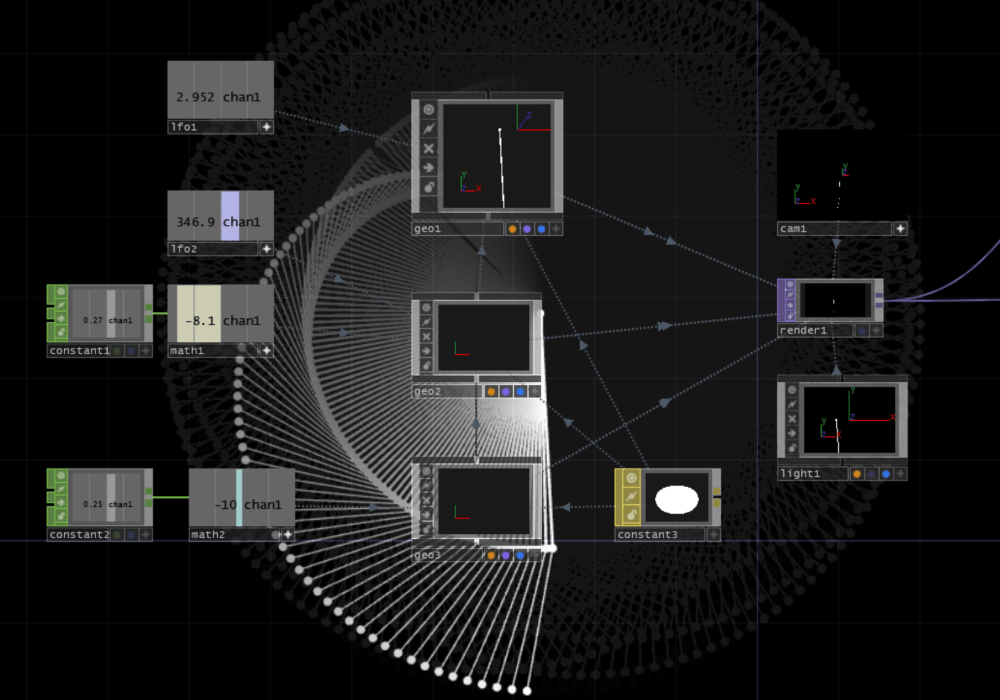
The following video shows a 3D render developed in TouchDesigner. Although this is named ‘Cymatic Landscapes’, my opinion is that it is a poor imitation of actual cymatic frequency formations. To the naked eye, the animation is of a high standard, and is visually captivating in motion, colour and texture but it lacks the geometric complexity, definition and resilient strength present in practical cymatic formation experiments.
(Derivative, 2017)
References:
Products of Interest (2003) Computer Music Journal 27, 112–120. [Online]. Available at: http://www.jstor.org/stable/3681600. [Accessed: 30 October 2017].
Lechner, P. (2014) Multimedia Programming Using Max/MSP and TouchDesigner. 1st ed. Birmingham: Packt Publishing.
Landon Speers (2009) ‘Alva Noto – u_07- Mutek_10’. [Online]. Available at: https://youtu.be/Lghn2FGHgOI. [Accessed: 30 October 2017].
Derivative (2017) ‘Matthew Ragan’s Cymatics Landscape’. [Online]. Available at: https://vimeo.com/207380152. [Accessed: 30 October 2017].
#Reflection
 Sonic Fluidity