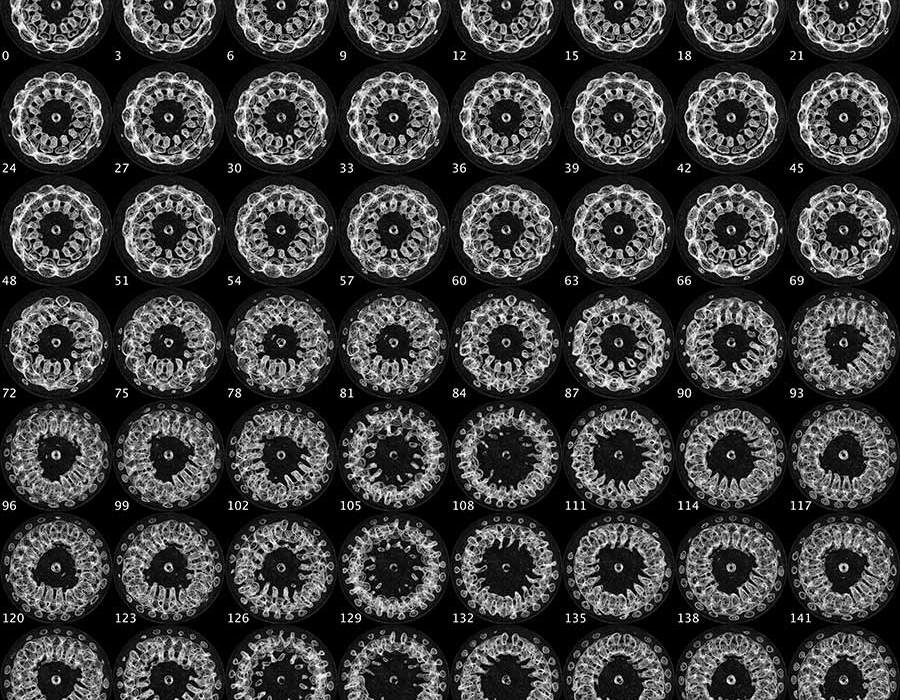
As I continue to research the plausibility of cymatic frequency in real-time, music-visualised performance, perhaps feeling a recurrence of concern towards my own scientific and creative capabilities to achieve such a feat. I subsequently discover a very compelling, newly published paper determining thorough, extensive experiments into Faraday wave behaviour in water. Having searched frequently on the University of Hertfordshire’s online library catalogue, sometimes being overwhelmed at the level of scientific complexity with many peer-reviewed sources, I was relieved to be able to coherently follow Sheldrake’s (2017) paper.
The unusual factor is how I discovered this paper, not via the university’s online library but from a page I follow on Facebook, called ‘Cymatics’. Personally I am not a huge advocate for Facebook, but it does at best enable the free flow of interesting, artistic, and scientific information, with this occasion being a true representation of that. Reading this paper provided me with an understandable insight into the complexities of Faraday waves that my previous blog posts have touched on, without going very deep. Perhaps something equally coincidental is that upon discovering this paper I was currently listening to comedian Russell Brand’s latest ‘Under The Skin’ podcast, with guest Rupert Sheldrake.
(Brand, 2017)
In this episode, Brand and Sheldrake discuss morphic resonance, consciousness and the universe in great depth, which could be considered beyond the typical range of conventional science. Listening to Brand discuss Sheldrake’s work and acknowledging the controversy surrounding much of his research methodology, reminded me of the similar stance some academics and those in the scientific community took towards the perspective of Hans Jenny’s experimental theories with cymatics in the 1960s. Would I be frowned upon for including this exciting, new paper in my annotated bibliography? There is definitely scope for acknowledging Sheldrake’s work in the need to bridge the gap between sound, matter, physicality, therapy and consciousness. However that is an entirely separate debate.
Without becoming too tangential in this post, a key factor in this paper towards my objective to include cymatic frequency and or Faraday waves in real-time music visualised performance, was the methodology in how to accurately create Faraday waves. Sheldrake (2017) determines that an analogous approach would provide a level of certainty to wave resonations that equations and technological algorithms could not compare due to their complexity and environmental randomisation. I am not convinced I fully understand the nature of these experiments, however this informs me that for real-time music visualisations, in cymatic or Faraday formations, would be more effectively executed with a physical installation with a cymascope or Chladni plate, as with Lauterwasser’s (2006) work.
(Zen Sound, 2014)
It seems that software applications, such as Max/MSP with Jitter or TouchDesigner could very well be programmed or reverse engineered to react to certain frequencies in sound. However the randomised, complexity of electronic music may prove to be a lengthy, scripted process without embracing the beauty of real-time formations that a physical installation could aspire to. Nonetheless, I am still somewhat speculating. My research continues.
References:
Sheldrake, M. & Sheldrake, J. (2017) ‘Determinants of Faraday Wave-Patterns in Water Samples Oscillated Vertically at a Range of Frequencies from 50-200 Hz’. WATER – Online Multidisciplinary Research Journal [Online]. Available at: http://waterjournal.org/volume-9/sheldrake. [Accessed 04 November 2017].
Brand, R. (2017) ‘Under The Skin: Rupert Sheldrake’. [Online]. Available at: https://youtu.be/dAS-QzWvj8g [Accessed: 07 November 2017]
Lauterwasser, A. (2006) Water Sound Images: The Creative Music of the Universe. Illustrated ed. USA: Macromedia Publishing.
Zen Sound (2014) ‘Water Sound Images Of A Gong by Alexander Lauterwasser’. [Online]. Available at: https://youtu.be/XXkZPfL4qLo [Accessed: 05 November 2017].
#Reflection
 Sonic Fluidity