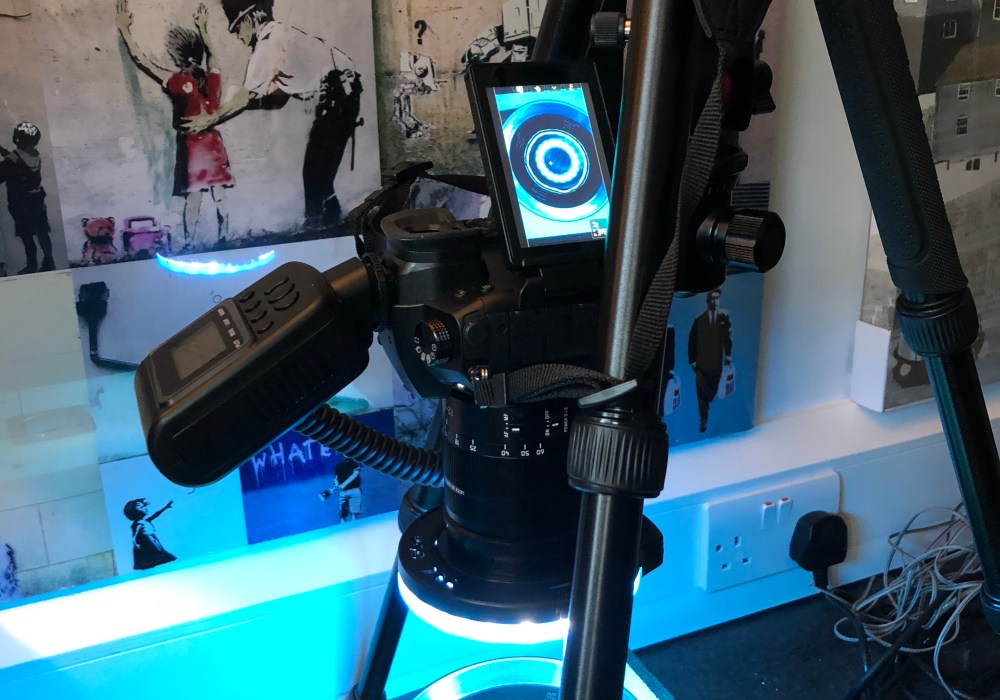
Having set up my newly purchased camera, along with the speaker and plastic dish, I was excited at the possibility to see water moving in cymatic formations to techno music. However, was it what I expected? Yes and no. Firstly, my tripod did not allow for the camera to be vertically central, placed above the dish. However this was quickly solved by ordering one that could. It arrived the following day, thank you Amazon Prime.


Secondly, the dish I managed to salvage was not ideal. Taking on board what other experimentalists have shared, the dish ideally needed to be black to allow for the camera to recognise light reflections in the fluid. The dish I initially tested had volume measurement markings on the base, so these were apparent in the footage recorded.
Finding another dish, which would offer a smooth base, allowing for no static, visual distractions when observed needed addressing immediately. My impatience was tested throughout this time as I tried to find a suitable dish by searching online. However, being creative is often the answer and stumbling across a plastic lid in the kitchen presented an opportunity.


The lid itself was from a pot of skin cream and bright white in colour. Therefore I set off to the local model store and acquired two different types of black spray paint and some sandpaper. There were a few manufacturing indentations on the inside of the lid, where the desired shape had been moulded. By using firstly a coarse, then fine textured sandpaper, I was able to smooth the inside base of the lid to a more desirable surface. This only took a matter of minutes and preceded the equally quick task of spraying the lid with black paint. A few coats later and a suitable dish was born. Utilising this worked particularly well and I began testing my own music, plus other tracks, played directly from vinyl, or Traktor Scratch through the Xone 96 mixer.
As I watched the water moving around the dish, it became more apparent that only bass and low-end vibrations gave predominance to fluid motion. This was recognised whenever there was a bass-drop or breakdown in any song’s sequence. With techno being a predominantly lowend genre, it dawned on me that perhaps relying on just the water motion to satisfy a visual show, might be lacking some variation. Having tested a variety of tracks, those with long release bass tones, textures and drones seemed to offer the best, lasting visualisation. Some with very rounded, syncopated beats also provided good visual patterns, however the aforementioned without beats seemed more immersive and pleasing on the eye.
If I’m honest, I was disappointed by this because it would mean that observing the Faraday Waves solely in their raw form would not provide as diverse an immersive visualisation in real-time performance as I had envisaged. Nobody likes boring, especially in the age of low attention spans. Other practical factors such as the poor life of the lens-light batteries, plus the water jumping out of the dish on unpredictably ‘bassy’ tracks, didn’t fill me with optimism. I felt defeated somewhat. It seemed I had dreamt up this vision without considering any basic practicalities, or my own knowledge of sound vibrations. Even having just graduated with an MSc in Audio Engineering at Distinction level. I guess I was fooled by the acute vibrations of specific frequency visualisations from other practitioners work. Maybe I require a better speaker? Unfortunately the Sony hi-fi speaker is my only choice at present, as the sub woofer I purchased specifically for this research remains unused, without the means of wired connection. I have to resolve that soon.
 Sonic Fluidity